

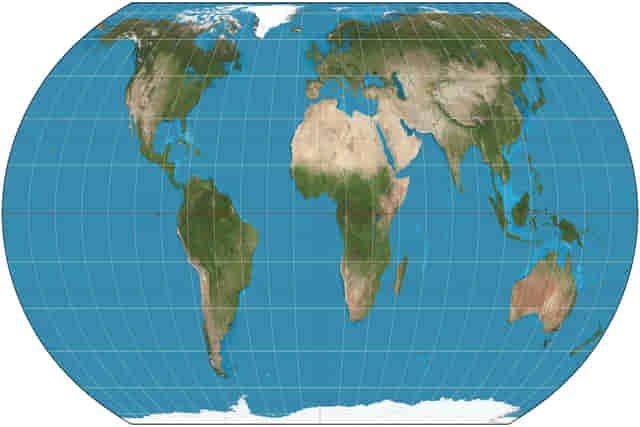

For generations, many of us have grown up looking at the same familiar world map. Europe appears large, Greenland looks almost as big as Africa, and countries near the equator can seem surprisingly small.
But the way we see the world may be changing.
On 4 September 2026, the United Nations General Assembly overwhelmingly adopted a resolution encouraging governments, schools, institutions and technology companies to use equal-area map projections, particularly the Equal Earth projection, when showing the comparative size of continents. The vote was 164 in favour, one against and six abstentions.
This does not mean the old world map has suddenly become illegal or that Google Maps will instantly change. Instead, it is an important shift in how the world is represented—and for travellers, it offers a fascinating new way to look at our planet.


Old World Map vs New World Map
The map most people recognize is based on the Mercator projection, created by Gerardus Mercator in the 16th century. It was designed primarily to make navigation easier because lines of constant compass direction could be represented as straight lines.
The problem is that this projection dramatically increases the apparent size of land near the North and South Poles.
That is why Greenland can look almost comparable to Africa on a conventional world map.
In reality, Africa is around 14 times larger than Greenland. The Equal Earth projection provides a much more accurate visual representation of the relative size of continents.
The United Nations says the objective is particularly important for education, geographical literacy and public understanding. The resolution also emphasizes that more accurate maps can help address the way Africa and other equatorial regions have historically been visually diminished.
Why Does a Map Matter to Travellers?
At first glance, a map might seem like a technical tool rather than something that affects your holiday.
But maps shape how we imagine distance, scale and importance.
Think about planning a trip across Africa. On a traditional Mercator map, Africa can visually appear smaller than you might expect. On an equal-area map, its enormous scale becomes much clearer.
Africa stretches across approximately 8,000 kilometres from north to south and contains an extraordinary variety of landscapes, cultures and travel experiences.
From the Sahara Desert and Morocco to the wildlife landscapes of Kenya and Tanzania, the beaches of Mauritius and Seychelles, the historic cities of Egypt and the mountains of South Africa, the continent is effectively a world of destinations within a continent.
A better map can therefore change not only geography lessons, but also our travel imagination.
How Could This Affect Travel Planning?
The UN resolution is not a travel regulation. It does not change international borders, flight routes, visa requirements or GPS navigation.
The resolution specifically encourages wider use of equal-area projections where comparing the size of continents matters. It does not prohibit the Mercator projection, which remains useful for navigation.
For travellers, however, the change could have several interesting effects.
1. A Better Understanding of Distance
Looking at an equal-area map can give travellers a better appreciation of how enormous some destinations really are.
A trip covering one country may involve distances comparable to travelling across several European countries.
This is particularly important when planning road trips, multi-city itineraries and continent-wide adventures.
2. Africa May Look Different on Travel Maps
For decades, Africa’s representation on common world maps has been visually reduced.
The Equal Earth projection brings the continent closer to its actual proportional size.
That could encourage travellers to look beyond the destinations they already know and discover more of Africa.
3. Geography Education Could Change
The UN resolution encourages governments and educational institutions to adopt more accurate representations of the world.
For future generations, the first world map they see at school could look very different from the maps many of us grew up with.
And that matters because our understanding of geography influences how we understand cultures, continents and global travel.
Will Google Maps and GPS Change?
Not necessarily.
This is one of the biggest misconceptions surrounding the announcement.
The UN has not ordered every mapping platform to replace Mercator immediately.
Mercator remains valuable for certain navigation applications, while equal-area projections are particularly useful when the goal is to compare the actual size of land masses.
In fact, the United Nations itself continues to publish different kinds of maps for different purposes. Its current Geospatial programme provides world maps and operational mapping products for humanitarian, peacekeeping and other applications.
So rather than thinking of this as “the old map is disappearing,” it is better to think of it as:
“We are gaining a more accurate way to see the world.”
The New Map, A New Way of Seeing the World
Travel is ultimately about perspective.
We travel because we want to see places beyond our everyday surroundings, understand different cultures and experience landscapes that may look completely different from home.
Maps do something similar. They give us a mental picture of the planet before we ever step onto an aircraft.
The UN’s move toward the Equal Earth projection is therefore more than a cartographic update. It is a reminder that the way we represent the world can influence the way we think about it.
The world itself has not changed.
Our picture of it has.
And perhaps that is the most exciting part for travellers: the next time you look at a world map, you may see Africa, South America, Asia and the rest of our planet with a very different sense of scale.
So before planning your next adventure, take another look at the map.
You might discover that the world is much bigger—and much more fascinating—than the map you grew up with.
Plan Your Next Journey
Whether you’re dreaming of exploring Africa, discovering Asia, travelling across Europe or planning your next international holiday, the right itinerary can turn a destination into an unforgettable experience.
Explore more travel inspiration and holiday ideas on Planet Earth Holidays – Travel Blog and start planning your next journey.
0 Comment